January 2026

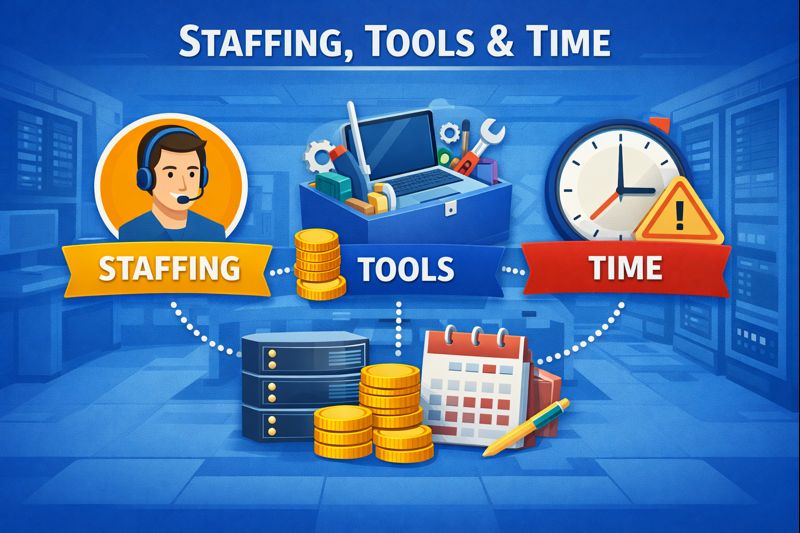
Staffing, Tools & Time: Why Enterprise IT Cost Models Are Being Rethought

Today, CIOs and IT Directors are being asked a harder question: What does our IT spend produce — resilience, security, modernization, or just maintenance? Here’s the reality: 🔹 Cyber expectations are rising — 24/7 monitoring, measurable maturity, compliance readiness. 🔹 Skills gaps are widening — specialized roles are expensive and hard to keep. 🔹 Tool […]

Staffing, Tools & Time: Why Enterprise IT Cost Models Are Being Rethought Read More »

Beyond Checkboxes: Quantifying Cyber Risk in Dollar Figures for the Board

I. Executive Summary: Why Cyber Risk Must Be Expressed in Dollars In boardrooms across the country, a shift is underway. For years, cybersecurity reporting leaned heavily on colorful charts, compliance scorecards, and technical vulnerability metrics. But those days are fading—quickly. Today, directors expect something different. They’re asking a simple question with bottom-line implications: “If this

Beyond Checkboxes: Quantifying Cyber Risk in Dollar Figures for the Board Read More »

Digital Transformation Budgeting: Leveraging Managed Services to Fund Innovation, Not Maintenance

Enterprise IT leaders all share a similar refrain: “We have big plans, but the budget is already spoken for.” Cloud modernization, AI initiatives, automation, and user-experience enhancements are all mission-critical priorities—yet most organizations can’t fund them adequately. The issue isn’t lack of vision. It’s that 70–80% of IT budgets are still consumed by maintenance, not

Digital Transformation Budgeting: Leveraging Managed Services to Fund Innovation, Not Maintenance Read More »

Staffing, Tools, and Time: Unpacking the Comprehensive Cost Comparison of IT Service Models

In enterprise IT, cost conversations are changing. What used to be a simple comparison of hardware, licensing, and headcount has evolved into a more complex equation—one shaped by accelerating cyber risk, a growing skills shortage, and the operational demands of hybrid infrastructure. Today, IT Directors must evaluate not only what IT costs, but what those

Staffing, Tools, and Time: Unpacking the Comprehensive Cost Comparison of IT Service Models Read More »

A Finance Director’s TCO Model for Managed Services: Moving from CapEx to OpEx

In today’s economic environment—shaped by unpredictable market cycles, constrained budgets, and rising cybersecurity demands—CFOs and IT leaders are under intense pressure to deliver more agility, resilience, and cost visibility. As a result, many enterprises are reevaluating the economics of technology ownership and shifting toward a consumption-based managed services model. This shift from CapEx-heavy infrastructure to

A Finance Director’s TCO Model for Managed Services: Moving from CapEx to OpEx Read More »

Stop Measuring Uptime: The Strategic Metrics for Your Next-Gen MSP Contract

For decades, uptime has been the gold standard of managed services performance. 99.9%. 99.99%, five nines, seven nines, etc. And yet, most enterprise IT leaders already know the uncomfortable truth: Uptime alone no longer defines success. In today’s enterprise environment—where IT is inseparable from revenue, security posture, and competitive advantage—measuring an MSP solely on availability

Stop Measuring Uptime: The Strategic Metrics for Your Next-Gen MSP Contract Read More »

Fair or FUD: Actionable Strategies for Cyber Risk Communication to Non-Technical Leadership

Cybersecurity leaders face a persistent and uncomfortable question from boards and executive teams: “Is this a real risk—or just fear, uncertainty, and doubt?” For C-level IT Directors and enterprise security leaders, the challenge isn’t identifying cyber risk. It’s communicating that risk in a way non-technical leadership understands, trusts, and can act on—without sounding alarmist or

Fair or FUD: Actionable Strategies for Cyber Risk Communication to Non-Technical Leadership Read More »

Why Every Multi-Vendor Business Needs a Trusted Advisor

Most organizations today rely on multiple service providers—IT, security, cloud, telecom, SaaS, and more. Each may perform well individually, but together they often create complexity, overlap, and gaps in accountability. The problem isn’t the providers. It’s the lack of coordination. A trusted advisor doesn’t replace service providers—they align them. Acting independently of vendor bias, a

Why Every Multi-Vendor Business Needs a Trusted Advisor Read More »

Boards don’t want heatmaps anymore — they want dollar figures.

Cyber leaders who can translate threats into financial exposure are winning budget, influence, and strategic relevance. Most security reporting still leans on acronyms, alerts, and compliance checkboxes. But the board speaks EBITDA, cash flow, and risk-adjusted ROI. The gap isn’t intelligence — it’s language. Quantification closes that gap. It turns “high risk” into: “$42M annualized

Boards don’t want heatmaps anymore — they want dollar figures. Read More »