IT Management Practices

Standardization Creates Stabilization

Standardization Creates Stabilization One of the biggest mistakes IT organizations make is treating every problem as unique. The result? More complexity, higher costs, and constant firefighting. Standardization is the foundation of a stable IT environment. When hardware, software, processes, and security policies are standardized: ✅ Support becomes faster. ✅ Security risks are reduced. ✅ Training […]

Standardization Creates Stabilization Read More »

How MSP Catalyst Aligns Technology to Business Value

Leveraging ITAM, FinOps, TBM & ITSM to Drive Measurable Outcomes Technology should not exist as an isolated function—it should directly enable growth, resilience, compliance, and profitability. Yet many organizations struggle with fragmented systems, unclear ownership of costs, and limited visibility into how IT investments translate into business performance. MSP Catalyst bridges that gap by aligning

How MSP Catalyst Aligns Technology to Business Value Read More »

Funding Growth: Using MSP Efficiency Gains to Accelerate Digital Transformation Projects

In most enterprises today, IT is no longer viewed as a support function—it’s a strategic engine expected to drive revenue, improve customer experience, and enable growth. Yet the biggest barrier to transformation isn’t innovation appetite. It’s capacity. IT teams are stretched thin maintaining legacy systems, fighting fires, and managing day-to-day operations. The result? Modernization efforts

Funding Growth: Using MSP Efficiency Gains to Accelerate Digital Transformation Projects Read More »

The IT Director’s Mandate: Aligning Every Dollar of IT Spend with Revenue Goals

For years, IT has battled a persistent reputation: a necessary cost center, expensive but unavoidable. But the post-2020 digital era has rewritten expectations. Business leaders no longer want IT to “keep the lights on”—they expect technology to drive revenue, accelerate innovation, and directly impact competitive advantage. As a result, IT Directors are experiencing the sharpest

The IT Director’s Mandate: Aligning Every Dollar of IT Spend with Revenue Goals Read More »

The Multiplier Effect: How Fewer Vendors Translates to Higher Operational Efficiency

Today’s IT mandate is clear: do more, faster, with less friction. And one of the most powerful, often overlooked levers to accomplish that is vendor consolidation. When done strategically—not just as a cost-cutting exercise—vendor consolidation creates a multiplier effect on operational efficiency. The fewer vendors you manage, the faster your organization moves. The less complexity

The Multiplier Effect: How Fewer Vendors Translates to Higher Operational Efficiency Read More »

Evaluating IT, vCIO Success by Business Alignment, Not Ticketing Speed

Ticket speed doesn’t define IT success. Business alignment does. For enterprise IT leaders, SLAs and ticket closure rates are table stakes—not strategy. A high-performing IT organization should be evaluated on: Alignment to business objectives, not tools Executive-level communication and decision support Living technology roadmaps tied to growth and risk Financial stewardship and cost transparency Proactive

Evaluating IT, vCIO Success by Business Alignment, Not Ticketing Speed Read More »

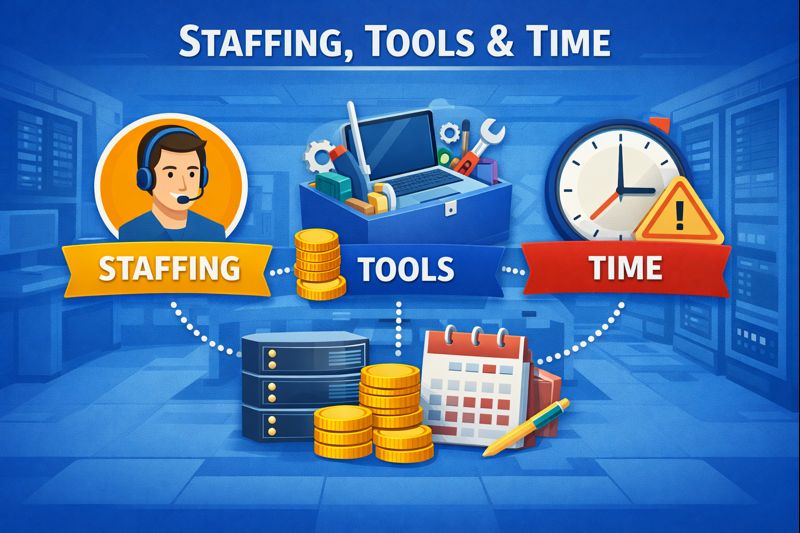
Staffing, Tools & Time: Why Enterprise IT Cost Models Are Being Rethought

Today, CIOs and IT Directors are being asked a harder question: What does our IT spend produce — resilience, security, modernization, or just maintenance? Here’s the reality: 🔹 Cyber expectations are rising — 24/7 monitoring, measurable maturity, compliance readiness. 🔹 Skills gaps are widening — specialized roles are expensive and hard to keep. 🔹 Tool

Staffing, Tools & Time: Why Enterprise IT Cost Models Are Being Rethought Read More »

Digital Transformation Budgeting: Leveraging Managed Services to Fund Innovation, Not Maintenance

Enterprise IT leaders all share a similar refrain: “We have big plans, but the budget is already spoken for.” Cloud modernization, AI initiatives, automation, and user-experience enhancements are all mission-critical priorities—yet most organizations can’t fund them adequately. The issue isn’t lack of vision. It’s that 70–80% of IT budgets are still consumed by maintenance, not

Digital Transformation Budgeting: Leveraging Managed Services to Fund Innovation, Not Maintenance Read More »

Staffing, Tools, and Time: Unpacking the Comprehensive Cost Comparison of IT Service Models

In enterprise IT, cost conversations are changing. What used to be a simple comparison of hardware, licensing, and headcount has evolved into a more complex equation—one shaped by accelerating cyber risk, a growing skills shortage, and the operational demands of hybrid infrastructure. Today, IT Directors must evaluate not only what IT costs, but what those

Staffing, Tools, and Time: Unpacking the Comprehensive Cost Comparison of IT Service Models Read More »